
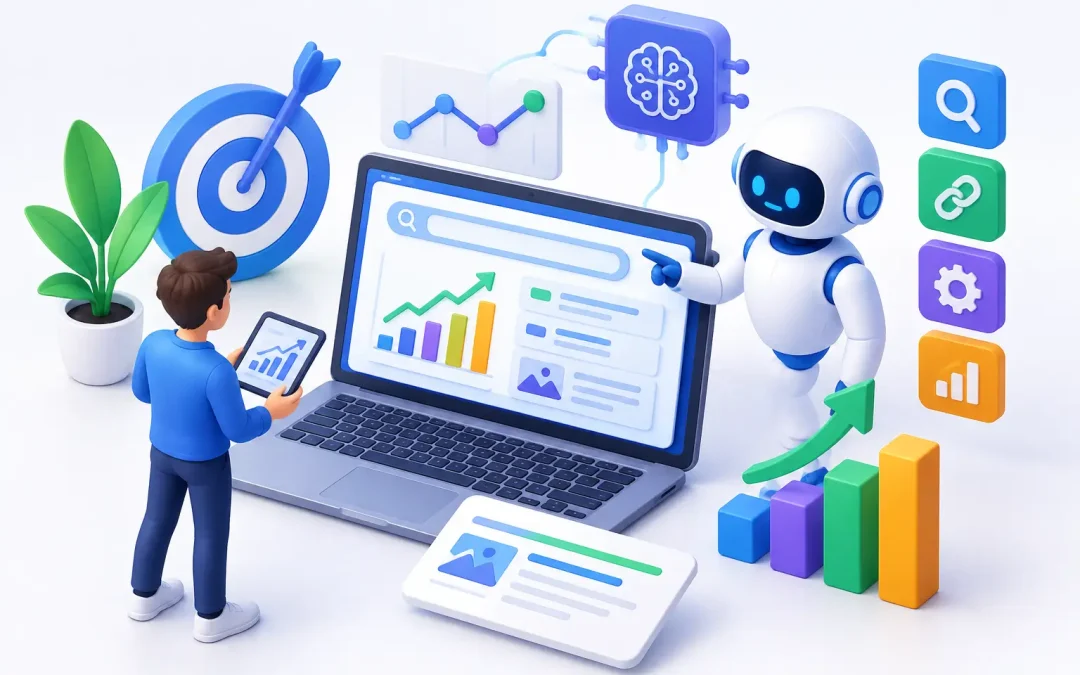
A dashboard can produce hundreds of keyword ideas before your first coffee. It cannot decide which search terms will bring profitable customers, whether your website can convert them, or how your brand should compete. That is the distinction a capable AI SEO agency must make. AI can accelerate SEO delivery, but it is not a replacement for commercial strategy, experienced judgement or accountable execution.
For Australian businesses facing crowded organic results and rising paid media costs, the appeal is obvious. Faster research, clearer reporting and more efficient content workflows can create momentum. The value, however, comes from turning that speed into better visibility, qualified traffic, leads and sales.
What an AI SEO agency should do differently
An AI-enabled SEO agency uses artificial intelligence to support research, analysis and optimisation across a campaign. That may include identifying keyword patterns, grouping search intent, reviewing technical issues, analysing competitors, forecasting opportunities and helping shape content briefs.
Used properly, these capabilities reduce time spent on repetitive tasks. A strategist can examine a larger set of search opportunities, a technical specialist can prioritise issues more efficiently, and a content team can work from stronger briefs. This gives businesses more time focused on decisions that affect revenue: which service pages need investment, which product categories have demand, and where conversion barriers are costing enquiries.
The risk begins when AI becomes the entire strategy. Generic copy published at scale, automated backlink outreach and unverified technical recommendations can weaken trust, waste budget and create a website that sounds like every other competitor. Search engines are designed to surface useful, credible results. More content is not automatically better content.
A strong agency treats AI as an operational advantage, not a shortcut around SEO fundamentals. White-hat optimisation, original expertise, reliable technical work and quality link acquisition still matter.
Faster research, better prioritisation
Keyword research has often been limited by time. A business may target the obvious high-volume phrase while overlooking specific searches that signal a genuine intent to enquire, book or buy. AI tools can process larger keyword sets and recognise relationships between searches more quickly than a manual spreadsheet review alone.
That does not mean every suggested keyword belongs in the campaign. Search volume can be misleading, particularly for local services and specialised B2B offers. A term with modest volume may generate more valuable leads than a broad phrase that attracts researchers, job seekers or people outside your service area.
The agency’s job is to test opportunities against commercial reality. For a Sydney trades business, that includes suburb-level demand, emergency versus planned work, service margins and the pages already competing in Google. For an eCommerce retailer, it means product availability, category structure, seasonal demand, price positioning and the likely value of each sale.
Content that earns attention rather than fills pages
AI can help outline an article, identify missing subtopics and compare a draft against common questions in search results. These are useful production tools. They do not create a distinctive point of view, verify a claim or understand the concerns customers raise during a sales call.
The best content combines data with business knowledge. It answers the question behind the search, makes the next step clear and reflects real experience. A local accountant can explain the practical implications of a tax change for small businesses. A flooring retailer can help buyers compare materials for Australian homes. An industrial supplier can provide specifications and purchasing guidance that a generic page will never cover well.
For commercial pages, the objective is not merely to rank. It is to help the right visitor act. Clear service descriptions, credible proof, logical internal navigation and considered calls to action all influence whether traffic becomes an enquiry or sale. AI can identify gaps in these pages, but skilled conversion optimisation is needed to resolve them.
Where AI adds the most value in SEO
AI delivers its strongest results when it is connected to quality data and reviewed by specialists. In an ongoing campaign, it can help an agency spot changes that deserve attention before they become expensive problems.
Technical SEO is one example. Large websites can contain broken internal links, duplicated metadata, poor indexation signals, slow templates and confusing navigation paths. Automated analysis can flag patterns at scale, allowing technical teams to investigate the source and determine the right fix. The recommendation still needs to be tested carefully. A change that helps one template may affect tracking, user experience or indexation elsewhere.
AI also improves performance reporting when it translates data into priorities. Business owners do not need a monthly document full of impressions with no context. They need to know which pages are gaining qualified traffic, where leads originate, which terms are improving, what is holding back growth and what work will happen next.
This is particularly valuable when SEO runs alongside Google Ads, paid social, email marketing or conversion rate optimisation. Search data can reveal language that improves ad copy. Paid campaigns can test demand before a large content investment. Analytics can show whether an organic landing page is attracting visitors but failing to generate action. Integrated marketing makes each channel more useful.
The limits businesses should understand
AI models can be confident and wrong. They may invent sources, misunderstand a niche service, use outdated information or make recommendations based on incomplete data. For regulated industries, health, finance, legal services and other high-trust sectors, that risk is significant.
There are also brand and compliance considerations. Content must sound like your business, reflect what you genuinely offer and avoid claims you cannot support. If every competitor uses the same tools and follows the same prompts, the result is a market full of bland pages with little reason for customers or search engines to choose one over another.
Link building requires similar caution. AI can help research relevant publishers, organise prospecting data and personalise early outreach. It cannot turn low-quality link schemes into a safe strategy. Sustainable authority comes from relevance, editorial standards and a natural backlink profile, not sheer volume.
Finally, no tool can guarantee rankings. Search results shift with competitors, algorithm updates, user behaviour and changes to Google’s result layouts. A credible agency discusses opportunity, measurement and risk rather than promising a number-one position by a set date.
How to assess an AI SEO agency
Ask prospective partners how AI is used in their workflow, but do not stop there. The more revealing question is who checks the work and how decisions are made. You should expect clear answers about the people responsible for strategy, content, technical optimisation and reporting.
Look for an agency that begins with your commercial objectives. If the business needs more qualified leads, the campaign should define what a qualified lead looks like, which services are most valuable and how enquiries will be tracked. If the priority is eCommerce growth, reporting should connect organic visibility to product revenue, category performance and conversion rates.
Transparency matters as much as technology. You should be able to see the planned work, understand why it has been prioritised and receive reporting that connects activity to outcomes. An in-house team with direct accountability is generally better placed to maintain standards than a model built around anonymous automation or outsourced production.
It is also reasonable to ask for examples of quality control. How is AI-assisted copy fact-checked? Who approves technical changes? How are link opportunities reviewed? What happens when rankings or conversions fall? The answers reveal whether AI is supporting a disciplined process or masking a low-cost content factory.
Building a practical AI-assisted SEO campaign
The right campaign usually starts with a detailed audit rather than a list of AI-generated recommendations. Your agency should review technical health, existing rankings, conversion paths, competitors, audience intent and analytics quality. From there, the work can be prioritised around the areas most likely to create commercial impact.
Early gains may come from repairing indexation issues, improving local landing pages or refining underperforming service content. Longer-term growth often requires consistent content development, link authority, technical refinement and conversion testing. The balance depends on your market, website maturity and internal resources.
At SEO Service Agency, the focus is on using data and intelligent tools to strengthen a bespoke, white-hat campaign, not to replace the people accountable for its results. The best use of AI is practical: remove repetitive effort, identify opportunities faster and give specialists more capacity to improve the work that customers and search engines actually experience.
Choose an agency that can explain the work in plain language, measure it against business outcomes and keep refining the strategy as the market changes. AI may make SEO faster, but the businesses that gain a lasting advantage will be those that pair it with expert judgement and consistent execution.