
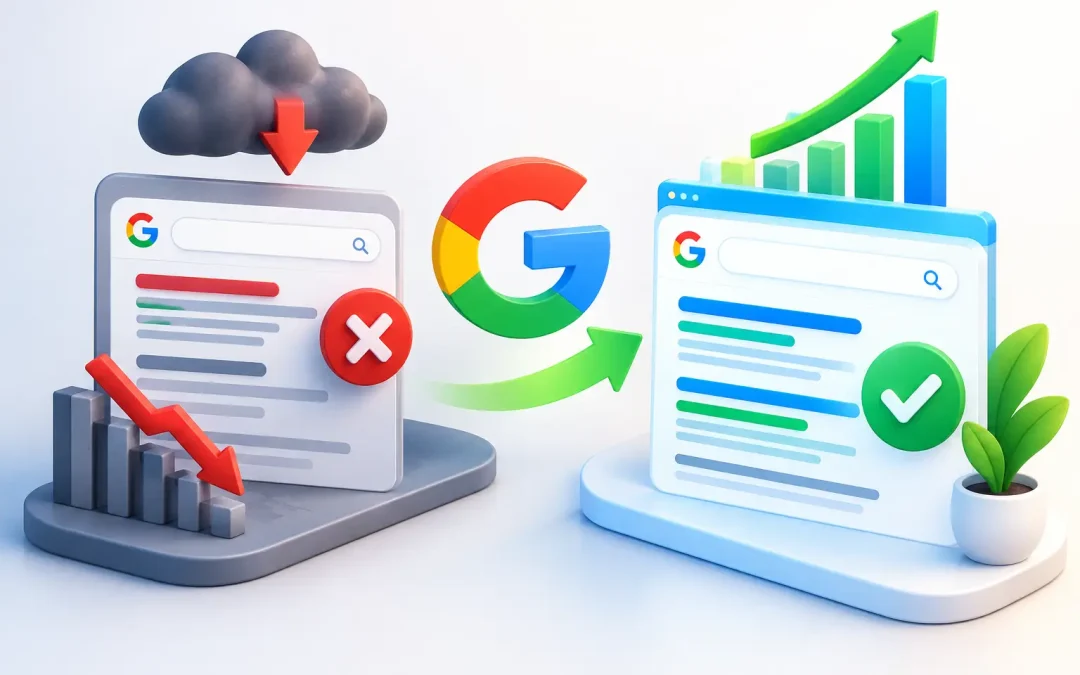
A sudden fall in Google rankings can turn a reliable source of leads into a costly question mark. When visibility, enquiries or eCommerce revenue drops without an obvious business reason, a Google penalty recovery service provides the forensic analysis and structured remediation needed to identify what changed and restore sustainable search performance.
For Australian businesses, the stakes are practical. A Sydney trades business can lose high-value local enquiries, while an online retailer may see product-category revenue disappear overnight. The right response is not to make rushed website changes or buy more backlinks. It is to establish the cause, remove risk and rebuild trust with a white-hat strategy that supports long-term growth.
What a Google penalty recovery service actually does
Penalty recovery is not a single fix. It is a specialist SEO process that investigates whether Google has applied a manual action, whether an algorithm update has reduced a site’s visibility, or whether another technical, content or market factor is responsible for the decline.
This distinction matters. A manual action is issued when Google reviewers identify a breach of its quality guidelines, such as manipulative link schemes, thin content or cloaking. It can affect an entire domain or selected pages, and it is generally visible in Google Search Console. Recovery requires the underlying issue to be corrected before a reconsideration request is submitted.
Algorithmic losses work differently. Google continuously refines how it assesses content quality, relevance, link authority, user experience and spam signals. There may be no notification, no reconsideration request and no quick reversal. The work instead involves improving the website so it better meets the signals Google is rewarding.
Not every ranking drop is a Google penalty. A site migration, an accidental noindex tag, broken internal links, slow mobile pages, stronger competitors or seasonality can all affect traffic. A credible recovery service starts by testing these possibilities rather than labelling every decline a penalty.
Diagnosing the real cause of lost rankings
Effective recovery begins with evidence. Ranking charts alone cannot explain why performance changed. An SEO specialist should compare the timing and scale of traffic losses with Google updates, website releases, indexation data, backlink trends and changes to priority landing pages.
The technical review checks whether Google can crawl, render and index the site as intended. Problems can include blocked pages, incorrect canonical tags, duplicate URLs, redirect chains, server errors, poor mobile usability and critical pages removed from the index. These issues can look like a penalty because the commercial result is the same: fewer pages appearing in search results.
Content is assessed for usefulness, originality and alignment with search intent. Pages created solely to target minor keyword variations, location pages with little genuine local value, copied product descriptions and outdated blog posts can weaken overall quality signals. The goal is not simply to publish more words. It is to make each important page more helpful for the customer and more clearly relevant to the query it should rank for.
Link analysis is equally important. Unnatural links may come from old SEO campaigns, low-quality directories, paid placements, irrelevant overseas sites or aggressively optimised anchor text. A strong backlink profile is built on genuine relevance and editorial value, not volume. Removing or disavowing harmful links may be appropriate, but only after careful review. Disavowing legitimate authority links without evidence can create further losses.
The recovery work: remove risk before chasing rankings
Once the cause is understood, remediation should follow a clear priority order. Urgent technical barriers are fixed first because content and link improvements cannot perform if Google cannot access key pages. Next comes the removal or correction of guideline breaches, followed by quality improvements that make the site more competitive.
For a manual action, the evidence trail matters. If paid or manipulative links were acquired in the past, the first step is to contact relevant webmasters and request removal where possible. A detailed record of outreach, removals and remaining links supports a transparent reconsideration request. Google does not expect perfection, but it does expect a genuine effort to address the problem rather than conceal it.
Content remediation is more selective than many businesses expect. Some pages should be rewritten with stronger expertise, clearer service information and original commercial value. Others may need consolidating into a single authoritative page to prevent duplication and keyword cannibalisation. Pages that offer no meaningful value may be removed or prevented from indexing.
Technical changes must be implemented carefully. A large-scale clean-up can unintentionally delete pages that still attract qualified traffic or remove rankings that are worth protecting. This is why recovery needs a staged plan, backups, testing and monitoring. Fast action is valuable, but careless action is expensive.
A white-hat recovery strategy also considers customer experience. Clear navigation, logical internal links, accurate business information, fast-loading mobile pages and persuasive calls to action do more than support SEO. They give recovered traffic a better chance of becoming leads, bookings or sales.
Rebuilding authority after the clean-up
Penalty recovery is not complete when a manual action disappears or a few rankings return. The business needs a stronger foundation than it had before. That usually means improving the pages closest to revenue, strengthening internal linking and earning relevant authority through useful content and legitimate digital PR or outreach.
For a local business, this can include well-developed service-area content, consistent business details and location-specific pages that reflect real service capabilities. For eCommerce stores, it may involve improving category copy, filters, product schema, out-of-stock handling and product information so shoppers and search engines can understand the range.
There is a trade-off here. Businesses often want traffic restored immediately, but aggressive shortcuts are commonly what created the problem. Sustainable recovery may take several months, particularly after a broad algorithm update or years of poor-quality link building. The right measure of progress is not only keyword positions. It is the recovery of qualified organic sessions, conversions, revenue and share of visibility for commercially valuable searches.
Choosing a Google penalty recovery service
A recovery partner should be able to explain what it knows, what it suspects and what still requires investigation. Be cautious of any provider that guarantees a fixed recovery date or promises first-page rankings before completing an audit. Google controls its own algorithms and review processes, so no agency can honestly guarantee an outcome.
Look for an approach that combines technical SEO, content strategy, backlink assessment, analytics and conversion thinking. A penalty rarely sits neatly within one channel. The best work connects the diagnosis to a commercially focused plan, prioritising pages and fixes that protect revenue while improving compliance with Google’s guidelines.
Transparent reporting is essential. You should be able to see the issues found, the actions completed, changes in indexation and visibility, backlink-removal progress, and the impact on leads or online sales. For internal marketing teams, this also makes it easier to coordinate developers, content writers and paid media activity while organic performance stabilises.
An in-house specialist team can provide greater accountability across this process. SEO Service Agency approaches recovery as part of a broader performance strategy, helping Australian businesses address the immediate ranking loss while improving the technical, content and authority signals needed to compete afterwards.
When to act on a suspected penalty
Act quickly if organic traffic drops sharply, priority pages vanish from Google, branded searches no longer return your website, or Search Console reports a manual action. Preserve data before making major changes. Record the timing of the decline, recent website updates, previous SEO activity and any links or content created by past providers.
Avoid deleting large sections of the site, changing every title tag or launching a new backlink campaign as a reaction. Those actions can obscure the original cause and make diagnosis harder. A measured audit gives your business a defensible recovery plan rather than another costly round of guesswork.
A rankings loss is frustrating, but it can also expose weaknesses that were limiting performance long before Google reacted. Address those weaknesses with care, keep every improvement focused on real customer value, and your website will be better placed to earn visibility that lasts.
Trackbacks/Pingbacks