
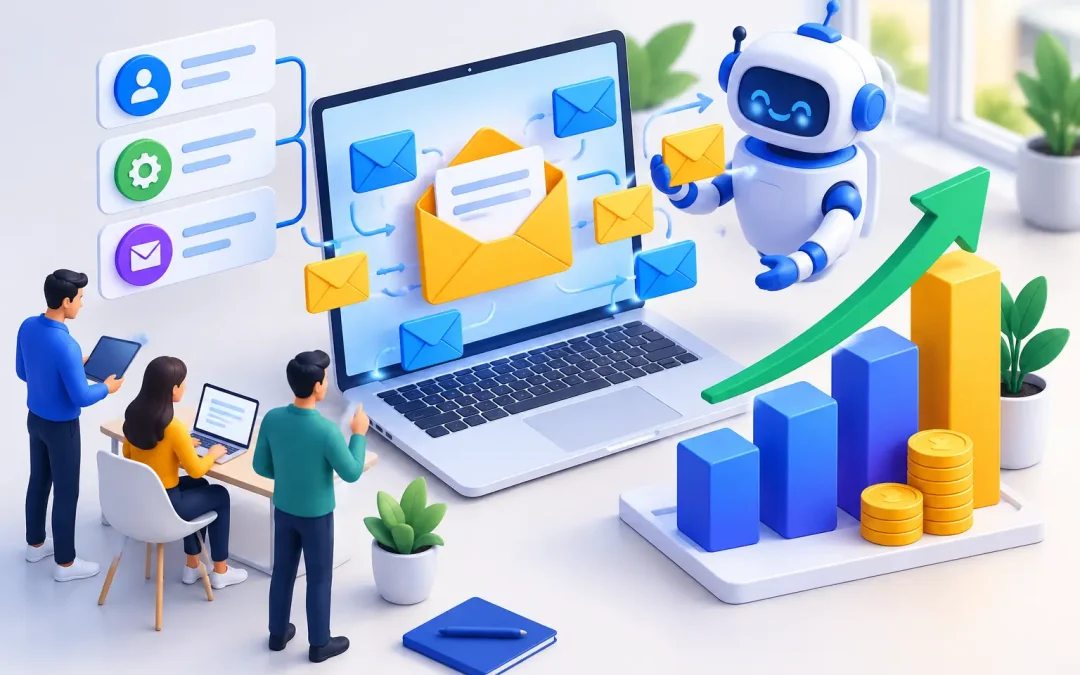
A new lead does not become a customer simply because they filled out a form, downloaded a guide or added an item to their cart. They need relevant follow-up at the right moment, without your team manually chasing every interaction. An email marketing automation agency builds those follow-up systems to turn initial interest into qualified enquiries, first purchases and repeat revenue.
For growth-focused businesses, email automation is not about sending more messages. It is about using customer behaviour, purchase history and lead quality to send fewer, better-timed emails that move people towards a commercial decision. Done properly, it supports your SEO, paid media, social campaigns and website conversion strategy rather than operating as a disconnected channel.
What an email marketing automation agency actually does
An email marketing automation agency plans, builds and improves automated customer journeys. These are rule-based email sequences triggered by actions such as joining a mailing list, requesting a quote, browsing a product category, abandoning a cart, making a purchase or becoming inactive.
The technical setup matters, but strategy matters more. A generic welcome email may produce a few opens, while a well-planned welcome journey can segment a prospect by their needs, introduce the most useful offer and create a clear next step. The difference is the connection between the message, the audience and the commercial objective.
For a service business, that objective may be booking a consultation. For an eCommerce retailer, it may be recovering abandoned carts, increasing average order value or encouraging a second purchase. For a B2B brand with a longer sales cycle, it may be educating leads until they are ready to speak with the sales team.
A capable agency works across the full process: customer journey mapping, audience segmentation, email copy and design, automation build, deliverability management, testing, analytics and ongoing refinement. It should also connect email activity to the website and CRM so reporting shows outcomes beyond open rates.
Where automation creates measurable growth
The strongest automation programs usually begin with a small number of high-value journeys. Businesses do not need dozens of complicated flows on day one. They need the right flows, aligned with the points where prospects commonly hesitate or customers need a reason to return.
Welcome journeys turn attention into action
A welcome sequence starts when someone signs up, downloads a resource or makes an initial enquiry. This is when interest is highest, yet many businesses send one generic confirmation email and then go quiet.
A more effective sequence acknowledges what prompted the sign-up, provides useful information, establishes credibility and directs the recipient to a logical next action. A Sydney-based professional services firm, for example, may use the sequence to answer common questions before offering a strategy call. An online retailer may use it to highlight best sellers, product benefits and an introductory offer.
The trade-off is frequency. Sending too little can waste a warm lead; sending too much can create unsubscribes and damage brand perception. The right cadence depends on purchase consideration, audience expectations and the value of each message.
Abandoned cart and browse flows recover revenue
Cart abandonment is not always a sign that a shopper has lost interest. They may have been interrupted, needed to compare options or wanted more confidence before purchasing. Automated cart emails give the business a second chance to address that hesitation.
Effective messages do more than repeat the product image and a discount code. They can reinforce delivery information, returns policies, product reviews, stock availability or compatibility details. If the brand relies on discounting every abandoned cart, it can train customers to wait for an offer. In many cases, reassurance and product education protect margin better than an immediate incentive.
Browse abandonment can also be valuable, particularly for retailers with considered purchases. It should be used carefully, with appropriate consent and sensible timing, so the brand feels helpful rather than intrusive.
Post-purchase sequences improve retention
The sale is the beginning of the customer relationship, not the end of it. A post-purchase automation can confirm the order, reduce buyer uncertainty, explain how to use the product and ask for a review at a suitable time.
For repeat-purchase businesses, it can also predict the next likely need. Skincare, consumables, pet products and specialty food brands can send timely replenishment reminders based on typical usage periods. Service providers can stay visible after a project by sharing maintenance advice, complementary services or relevant case studies.
Retention often produces a better return than continually paying to acquire the same type of customer again. Email automation gives businesses a practical way to increase lifetime value while keeping communication relevant.
Re-engagement protects list quality
Not every subscriber remains active. A re-engagement sequence can identify contacts who have stopped opening or clicking, invite them to update preferences and remove disengaged records where appropriate.
This may feel counterintuitive because it reduces list size. However, a smaller list of genuinely interested subscribers is more valuable than a large database that drags down engagement and deliverability. Sending repeated campaigns to inactive contacts can make it harder for important messages to reach engaged customers.
Why segmentation matters more than a bigger database
An email list is only as useful as the information attached to it. When every subscriber receives the same campaign, the message will be highly relevant to a small group and merely tolerable to everyone else.
Segmentation lets businesses tailor communication based on meaningful signals. These may include location, lead source, pages visited, service interest, purchase category, order value, previous engagement or stage in the buying process. A prospect who arrived through a Google Ads campaign searching for a specific service should not receive the same messages as an existing customer who has already purchased.
The goal is not to create dozens of tiny segments that are difficult to manage. It is to identify distinctions that materially change the message or offer. Strong segmentation makes campaigns more relevant, protects marketing spend and gives sales teams better context when a prospect is ready for direct contact.
How email should work with SEO, paid media and conversion optimisation
Email automation performs best when it is integrated with the wider marketing program. SEO and content marketing attract people searching for answers. Paid media generates immediate demand and brings targeted visitors to key landing pages. Email continues the conversation when visitors are not ready to convert on their first session.
This connection also improves attribution. If an organic search visitor downloads a guide, joins an email sequence and books a consultation two weeks later, the business should be able to see the role each channel played. Treating email as a standalone channel can lead to poor decisions, such as underinvesting in content that creates valuable leads or overvaluing a final-click campaign.
Landing page quality is equally important. Automation cannot compensate for unclear offers, slow pages or forms that ask for too much information. Conversion rate optimisation and email strategy should be planned together so the customer journey feels consistent from ad or search result through to enquiry, purchase and follow-up.
What to look for when choosing an email marketing automation agency
The right partner should begin with your business model, sales process and customer data, not a pre-packaged template. Ask how the agency will define success. If the answer is limited to opens and clicks, the reporting is too narrow. Engagement metrics are useful diagnostic signals, but leads, revenue, repeat purchases, booked appointments and customer lifetime value are the measures that matter.
You should also expect transparency around deliverability, data handling and platform ownership. Your business should retain access to its contact database, automation account and performance data. An agency can manage the work, but the underlying customer asset belongs to you.
Experience across strategy, copy, design, data and technical implementation is valuable because automation can fail at several points. A visually polished email cannot fix weak segmentation. Clever copy cannot overcome poor timing. Sophisticated workflows will not deliver results if tracking is unreliable or leads are not followed up by the sales team.
For businesses running multiple digital channels, an integrated agency model can offer an advantage. When the same team understands your search strategy, paid campaigns, analytics and website performance, it is easier to build email journeys around genuine customer behaviour rather than assumptions.
Start with the revenue leaks closest to conversion
The quickest opportunity is rarely a complete rebuild of every email campaign. Start by identifying where valuable prospects and customers currently fall away. It may be unanswered web enquiries, abandoned carts, a weak welcome process or past customers who never hear from you again.
Build the first automation around that commercial gap, measure its contribution and refine it over time. With the right strategy and accountable reporting, email becomes a reliable growth channel that keeps working after the initial click has passed.